
Suwannee County Sex Offender Checks
The official starting point is the Florida Sexual Offenders and Predators Search. FDLE lets a reader search statewide records by person or location and narrow a place search to Suwannee County. A full or partial name can work. A blank name paired with county, city, ZIP, or address criteria can reveal records tied to that place. Result cards link to the detailed flyer and show whether Florida classifies the person as a sexual offender or sexual predator.
The Suwannee County Sheriff's Office has a different role. Its staff registers people locally, collects required updates, and receives reports of suspected failure to comply. FDLE publishes the public search and flyer. The federal National Sex Offender Public Website adds a cross-state layer when a person may have moved beyond Florida. Use all three roles with care: FDLE for Florida public data, the Sheriff for local compliance questions, and NSOPW for a broader geographic search.
Suwannee Registration at Pine Avenue
The Sheriff's local offender-registration page directs registrants to the Suwannee County Jail at 305 Pine Avenue in Live Oak. Registration is offered Tuesday and Thursday from 8 a.m. to 4 p.m., excluding holidays. The jail number is (386) 364-3595. A registrant should bring photo identification. The office estimates about 30 minutes for a visit that includes offense information, fingerprints, and photographs.
The Sheriff's published registration schedule shows the local intake instructions.
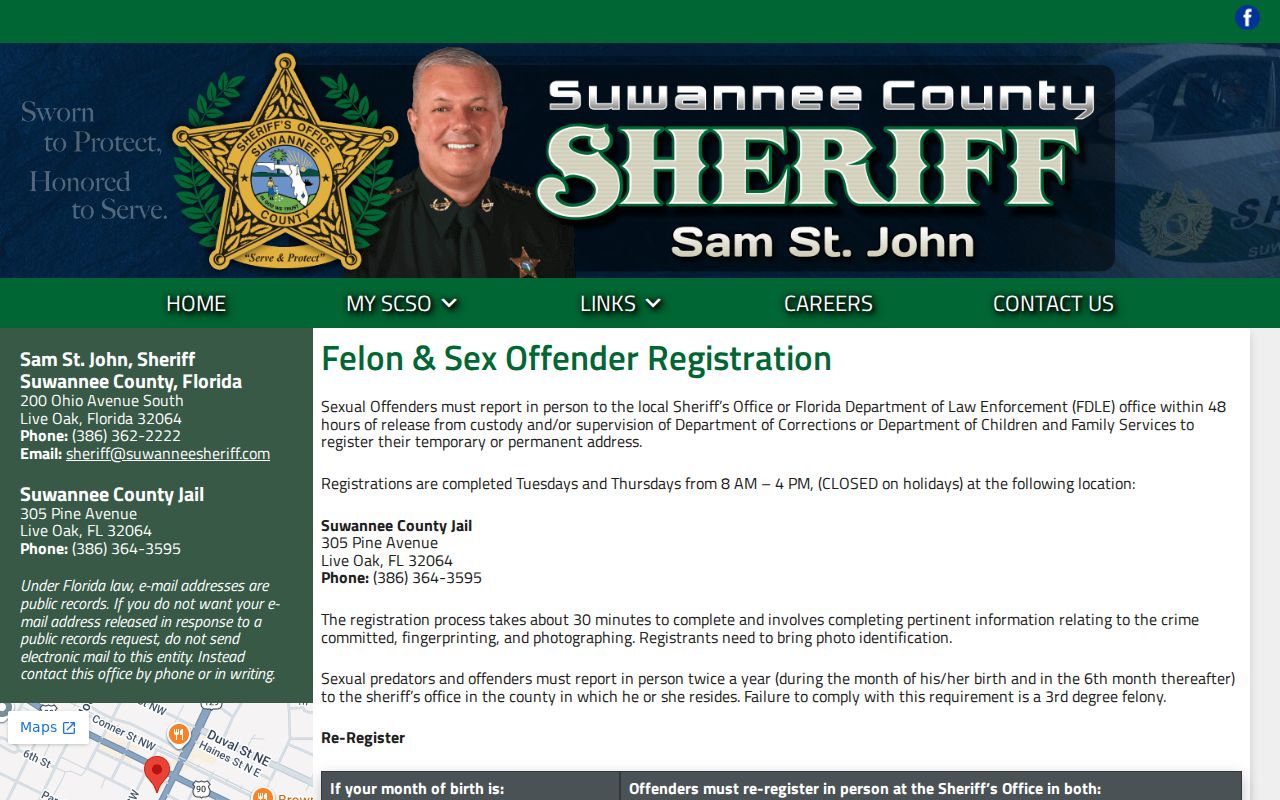
It confirms that local reporting takes place through the jail registration office rather than through the public FDLE search screen.
Suwannee County Jail Registration
305 Pine Avenue
Live Oak, FL 32064
(386) 364-3595
Tuesday and Thursday, 8 a.m.-4 p.m., except holidays
The local schedule is an administrative channel, not a public roster. Members of the public should use FDLE's registry to view released information. Suspected noncompliance can be reported to the Sheriff's Office or to FDLE without approaching the person.
Florida Registry Searches
FDLE's search supports both a person lookup and geographic discovery. “More Options” can limit designation to Sexual Offenders, Sexual Predators, or Both. Status filters include absconded, confined, deceased, deported, released subject to registration, and several supervision categories. State Status separates in-state and out-of-state persons. Searchers may also include aliases and small thumbnail images.
- Open the FDLE registry and read its public-use notice.
- Enter a full or partial name, or choose Suwannee County and add a city, ZIP, address, or radius when useful.
- Compare the result card's name, image, status, address type, source, and received date. Do not rely on a name alone.
- Open “View Flyer” and inspect the full profile, qualifying offense, adjudication, address history, vehicles, and compliance details.
| Field Label | Type | Required | Notes |
|---|---|---|---|
| Last Name | Text | Mode-dependent | Full or partial name accepted |
| First Name | Text | Optional | Helps narrow common surnames |
| City / ZIP | Text or select | Optional | Geographic narrowing within Florida |
| County | Dropdown | Optional | Select Suwannee for county results |
| Address / Radius | Text and dropdown | Radius mode | Location search reaches up to five miles |
Three Official Registry Views
The FDLE offender and predator search form shows the official controls used for a Suwannee County lookup.
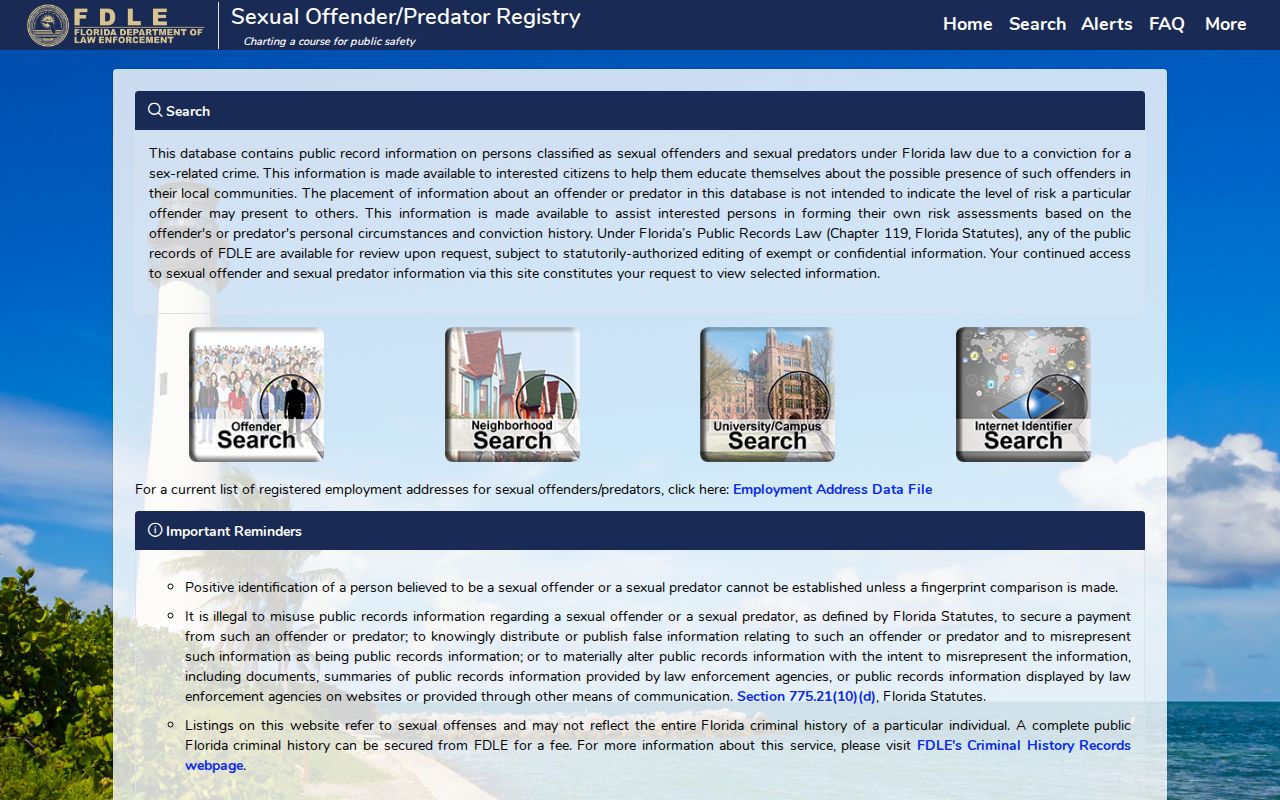
Those controls make location and designation filters visible before a reader opens any individual flyer.
The FDLE registry FAQ explains what Florida releases and how its flyer should be read.
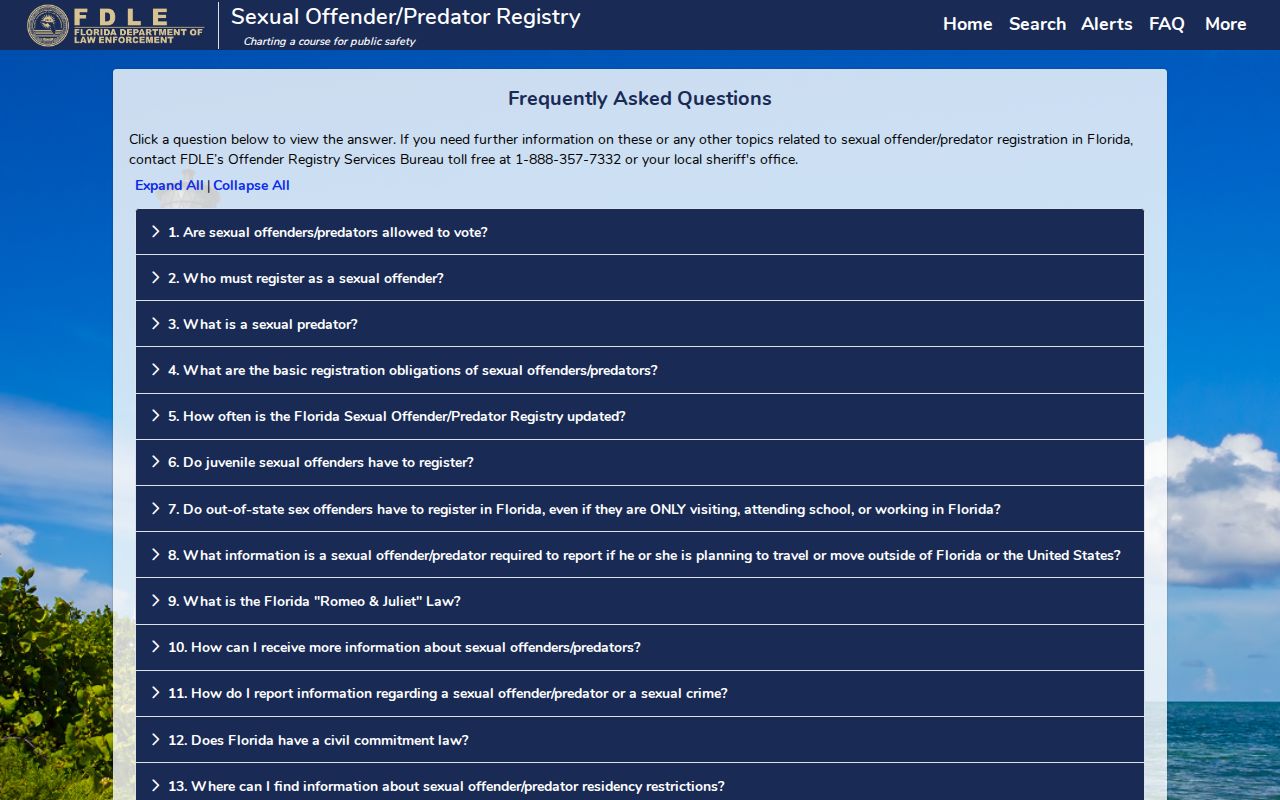
The guidance reinforces why the profile's source and received date matter more than a copied list.
The FDLE check-options page distinguishes registry access from Florida criminal-history products.
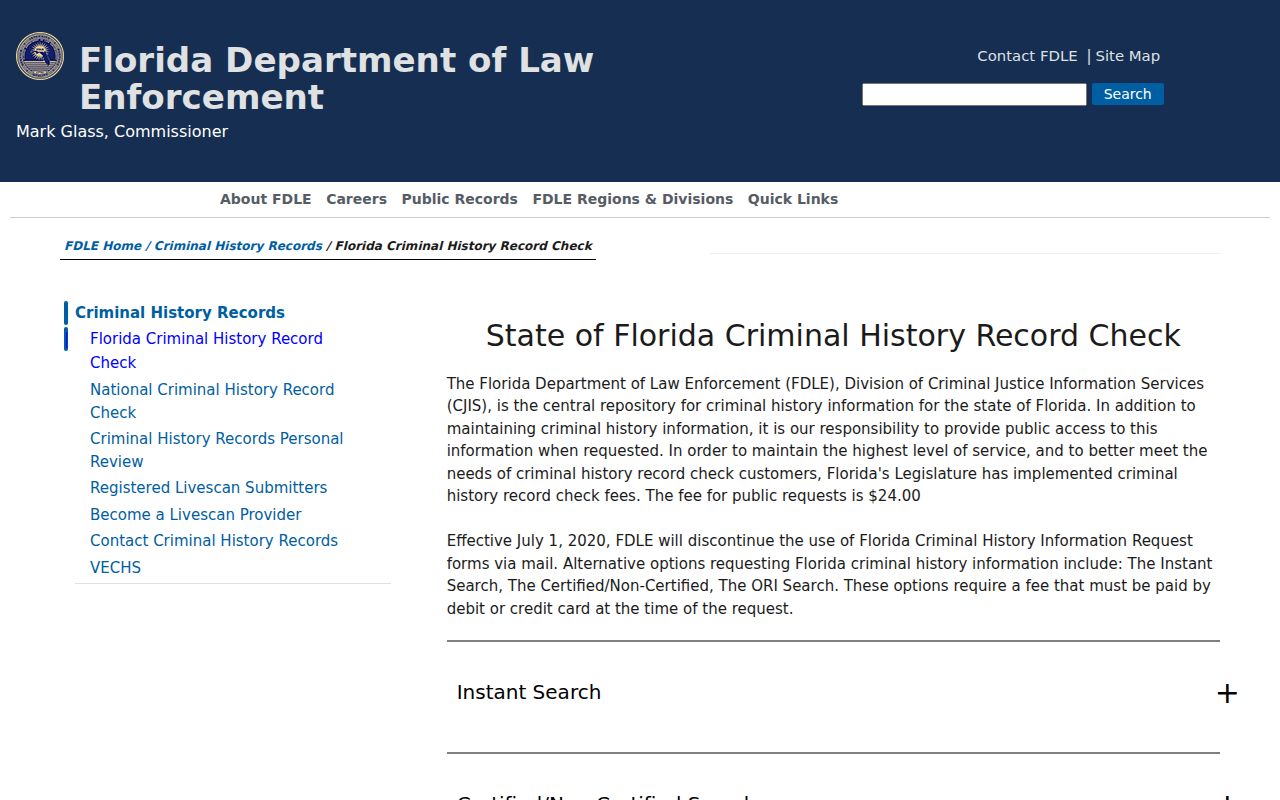
A registry flyer answers a focused public-safety question. It is not the same record as an FDLE criminal-history response.
Registry Profiles: What They Show
A Florida flyer combines identity, location, adjudication, and compliance details. It can list permanent, temporary, and transient addresses, each with a source and received date. Those dates help a reader judge freshness. The profile can also include vehicles and a map link. It does not become a full criminal history merely because it lists a qualifying case.
| Name & Aliases | Displayed identity plus known aliases used to help distinguish people |
|---|---|
| Photo & Description | Photograph, age, sex, race, height, weight, hair, eyes, scars, marks, and tattoos |
| Registered Address | Permanent, temporary, or transient locations with source, received date, and map link |
| Offense & Case | Crime description, statute, adjudication date, case number, jurisdiction, outcome, and victim indicators |
| Designation | Florida sexual offender or sexual predator, rather than a public Tier I, II, or III label |
| Status | Legal, supervision, registration, and compliance information, including absconded status when applicable |
Read the Address Date
Result cards and flyers identify the address type, the source, and the date FDLE received it. That context can prevent a common error: treating an old copied address as current. FDLE describes the live registry as real-time, while a downloadable address list refreshes every four hours and begins aging once it is generated. Open the flyer instead of relying on a screenshot or third-party repost.
Results can show 5, 10, 15, 20, or 25 rows per page. A user may select up to 25 records for PDF export. Export is useful for a point-in-time review, but the live profile remains the better place to confirm changes. “Track Offender” and the address source provide more useful context than a bare pin on a map.
Note: A received date shows when FDLE obtained the address information, not a promise that the person is physically present at that moment.
Registration Levels and Duties in Florida
Florida does not publish a simple three-tier table. Its key public designations are sexual offender and sexual predator. Duties and duration depend on the qualifying statute, designation, and individual legal history. Sections 943.0435, 775.21, and 944.607 supply the main rules. The Suwannee Sheriff states that offenders report within 48 hours after release from custody or supervision and appear twice each year, in the birth month and the sixth month after it. Predators and some other categories report more often.
| Level / Tier | Duration | Verification Frequency |
|---|---|---|
| Sexual offender, §943.0435 | Generally life; a narrow petition path may exist after at least 25 sanction-free years for eligible people | Local in-person verification and statutory reporting; Suwannee states twice yearly for offenders |
| Sexual predator, §775.21 | Life, with no ordinary petition-removal route absent a full pardon or conviction being set aside | Address verification at least quarterly; in person during birth month and every third month after |
| Romeo-and-Juliet removal, §943.04354 | Special court process only when detailed age, consent, and sole-offense conditions are met | Not automatic; court findings control |
Enroll in Suwannee Sheriff Alerts
The Sheriff's official registry page links to Suwannee offender email-alert enrollment. Florida's separate Offender Alert service can monitor several addresses and track a particular registrant's statewide address changes. Alerts reduce the need to repeat the same manual place search.
Community notice has rules of its own. For a predator, Florida law calls for local notice that can include the person's name, photograph or description, addresses, offense circumstances, and whether the victim was an adult or minor. The victim's name is excluded. Within 48 hours, the sheriff or police also notifies licensed childcare facilities and schools within one mile as required by law.
Suwannee Residence Rules Need Context
Florida's section 775.215 creates a 1,000-foot residence restriction near schools, daycare centers, parks, and playgrounds for specified convictions. It is inaccurate to apply that rule to every person in the registry without checking the qualifying conviction and dates. The flyer and statute provide a starting point, but a legal question about one person's restriction belongs with the responsible agency or a Florida attorney.
Likewise, offender and predator are legal designations. They are not informal risk scores. A predator marker carries specific registration and notice consequences, while an offender's duties still depend on the statute and case. Read the stated designation and qualifying offense rather than translating Florida records into federal tier labels.
When a Person Crosses State Lines
A Florida search may show an out-of-state status, but the U.S. Department of Justice NSOPW search is the better fallback for a multi-state question. Search broadly when the last known location is uncertain, then open the source jurisdiction's official profile. NSOPW gathers participating jurisdiction results; the source registry remains responsible for its record.
If a result suggests a reporting problem, do not confront the listed person. Contact the Suwannee County Sheriff's Office or FDLE's registry bureau at 1-888-357-7332, weekdays from 8 a.m. to 5 p.m. Eastern. Give the agency the profile details and the reason for concern. Staff can compare that report with nonpublic compliance information.
Using Registry Information Lawfully
Registry information exists for public awareness and safety planning. A sound use is to understand a neighborhood, enroll in an official alert, discuss age-appropriate safety with family members, or give suspected noncompliance to law enforcement. It is not permission for surveillance, confrontation, threats, or punishment. The record can also change, so verify the current FDLE flyer before acting on any copied information.
Misuse can be a crime: Florida Statutes §775.21 warns that using registry information to injure, harass, or commit a criminal act against a registrant or that person's family is prohibited and can lead to criminal penalties.